A disjoncteur is a type of disconnector used in power systems that, in addition to switching the load on and off, is also responsible for protecting the system. Disjoncteur is a French word, and its English equivalent is circuit breaker (CB). In Persian, it is referred to as power switch or breaker/disconnector.
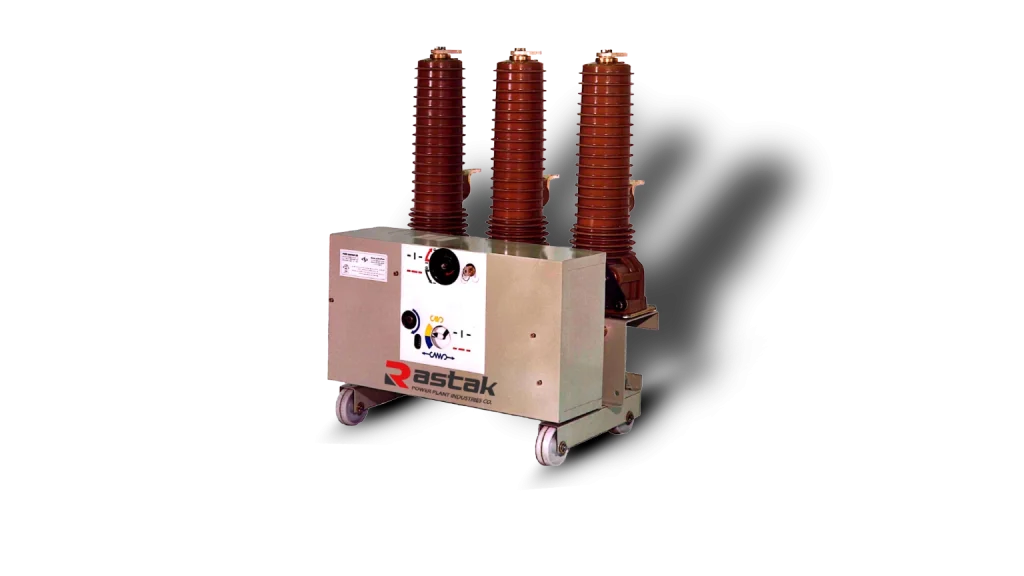
✔ Oil Circuit Breaker (OCB)
✔ Air Circuit Breaker (ACB)
✔ Vacuum Circuit Breaker (VCB)
✔ Minimum Oil Circuit Breaker (MOCB)
✔ Gas Circuit Breaker (GCB)
In these breakers, oil acts as the insulating medium. As soon as the contacts separate, the resulting arc vaporizes the oil, generating high-pressure gases. These gases circulate the surrounding oil, cooling the arc zone and ultimately extinguishing the arc.
Advantages:
✔ Internal chamber visibility
Disadvantages:
✔ Requires a large amount of mineral oil inside the chamber
✔ Risk of oil fire and possible spillage
✔ Environmental hazards
✔ Requires periodic maintenance
The mechanism of this breaker relies on blowing compressed air into the contact separation zone using an air compressor. The high-velocity compressed air cools and extinguishes the ionized gases caused by the arc, while simultaneously forcing the contacts apart.
Advantages:
✔ High-speed operation
✔ Easy maintenance
Disadvantages:
✔ Requires compressed air pipelines and auxiliary compressor equipment
✔ High cost
✔ Produces significant noise during operation
✔ Large physical size
These breakers operate in a sealed vacuum chamber, free of oil, gas, or air. The absence of ionized particles prevents arc formation.
Advantages:
✔ Minimal maintenance requirements
✔ No fire risk due to absence of oil
✔ Silent operation due to high sealing
✔ Vacuum provides a very high dielectric strength (8× air, 4× SF₆ gas)
✔ Compact size
✔ High switching frequency
Disadvantages:
✔ Requires lightning arresters and surge arresters for protection
✔ Cannot be repaired on-site if damaged
✔ Loss of vacuum renders the breaker unusable
Gas circuit breakers use sulfur hexafluoride (SF₆) gas as the insulating and arc-quenching medium. Due to issues with oil circuit breakers, SF₆ became widely adopted because of its superior properties: 2.5× dielectric strength of air, 100× better arc-quenching capability, 5× density, and 3.7× better thermal conductivity. Introduced in 1977 by General Electric, SF₆ allowed for smaller breaker sizes and quieter operation. The gas is non-toxic, odorless, and remains sealed inside the chamber without leakage.
Advantages:
✔ No fire risk compared to oil breakers
✔ Non-flammable insulating gas
✔ Simple operating mechanism
✔ Requires less maintenance
✔ Cost-effective
✔ More compact than alternatives