The electronic control boards manufactured by Rastak Power Plant Industries act as the “brain” of diesel generators, responsible for monitoring, regulating, and managing their operation. These boards directly influence the efficiency, safety, and service life of the generator. Depending on the selected control system, diesel generator boards are generally categorized into three main types: Manual, Automatic, and Synchronizing.
✔ Manual operation: In manual systems, the operator must directly control the generator. This type is generally used for simple operations where closer supervision is required.
✔ Voltage and frequency adjustment: In manual boards, the operator regulates output voltage and frequency via buttons or knobs on the control panel.
✔ Basic functionality: Designed for essential tasks such as start/stop, monitoring engine status, and supervising basic operating parameters.
✔ Low cost & simplicity compared to advanced systems.
✔ Full operator control over the generator’s performance.
✔ Suitable for small-scale or specialized projects without the need for automation.
✔ Requires constant monitoring by the operator.
✔ Higher chance of human error, which can cause operational issues or equipment damage.
✔ Automatic control: The board continuously monitors system conditions and automatically manages generator operation.
✔ Auto start/stop based on load: Activates the generator when power from the grid fails and switches it off once utility power is restored.
✔ Automatic voltage and frequency adjustment without manual intervention.
✔ User-friendly and efficient, requiring no manual supervision.
✔ Provides optimized performance in various load conditions.
✔ Time-saving due to full automation.
✔ Equipped with built-in protection systems (e.g., overload, overheating shutdown).
✔ Designed for synchronization with the utility grid or multiple generators.
✔ Precise control of voltage and frequency to match grid parameters.
✔ Load sharing capabilities, ensuring optimal fuel consumption and longer generator life.
✔ Perfect coordination with the grid or multiple power sources.
✔ Improves efficiency and fuel economy.
✔ Allows parallel operation of multiple generators, ideal for high-demand applications.
Electronic control boards are a critical component of diesel generators, ensuring proper operation and efficiency. The choice between manual, automatic, or synchronizing boards depends on project requirements, energy consumption, site conditions, and automation needs. While manual systems are cost-effective for simple applications, automatic and synchronizing boards offer advanced features, greater security, and optimized long-term performance.
At Rastak Power Plant Industries, thanks to our expertise in multiple large-scale projects, we recommend and supply the most suitable control board tailored to each site’s operational logic and philosophy.
DSE7320-MKII – [Download Catalog]
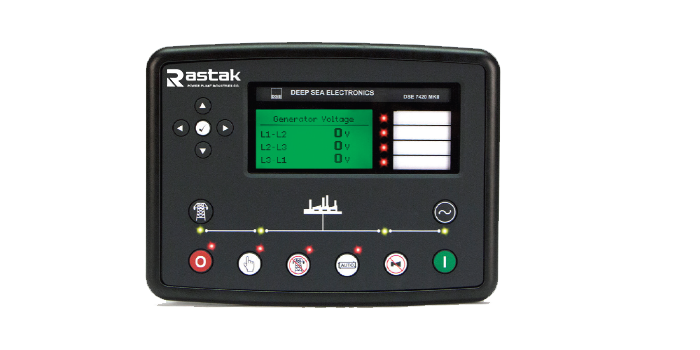
DSE7420-MKII – [Download Catalog]
DSE8610-MKII – [Download Catalog]
DSE8620-MKII – [Download Catalog]
DSE8660-MKII – [Download Catalog]
DSE8680-MKII – [Download Catalog]
DSE8900-MKII – [Download Catalog]
PS0600 – [Download Catalog]
PC1.2 – [Download Catalog]
PC2.2 – [Download Catalog]
PC3.3 – [Download Catalog]
The AVR (Automatic Voltage Regulator) is a key electronic component that stabilizes the generator’s output voltage. Its role is to maintain steady voltage despite load fluctuations or varying operating conditions.
✔ Regulates output voltage continuously, correcting fluctuations.
✔ Controls alternator field current to adjust voltage accordingly.
✔ Responds quickly to load variations, ensuring stability.
✔ Protects sensitive equipment from voltage spikes or drops.
AVRs come in analog and digital models, with digital types offering higher precision and faster response.
The governor is a device responsible for regulating the diesel engine’s speed by adjusting the fuel supply. It ensures stable operation even when load demand changes.
✔ Maintains constant engine speed under varying loads.
✔ Performs automatic adjustments when load increases or decreases.
✔ Prevents overspeeding or underspeeding, protecting the engine and generator system.
✔ Mechanical governors – using levers, springs, and weights.
✔ Electronic governors – equipped with sensors and electronic circuits, providing higher precision and faster response.